Your Sales Team Is Bleeding Time. AI Should Have Fixed This Already.
The average sales rep loses 10+ hours a week to admin tasks AI should already handle. Here's what's actually being automated in 2026 — and how a unified AI stack compounds results quarter after quarter.
Here's a number that should make every revenue leader uncomfortable: $87.
That's what the average sales professional pays every single month — $20 for ChatGPT, $20 for Claude, $17 for a transcription tool, $30 for automation middleware — to string together a workflow that still requires them to manually copy, paste, and chase.
At a team of 50, you're burning over $40,000 a year on a fragmented AI stack that was never designed to work together. And yet, the meeting notes still pile up. The CRM is still three calls behind. The follow-up emails still don't go out until Thursday.
This isn't an AI problem. It's an architecture problem.
The AI Revolution in Sales Is Real. Most Teams Are Still Missing It.#
AI adoption in sales and marketing has crossed from "early adopter" territory into operational necessity. Teams running disconnected point solutions are watching the gap compound — while unified AI organizations are pulling ahead on pipeline velocity, conversion rates, and rep productivity.
The question is no longer whether AI transforms sales. It's which teams are capturing that transformation — and which ones are still paying $87/seat to do it manually.
What AI Is Actually Replacing (The Honest List)#
Vague claims about "AI transforming sales" don't help anyone. Here's what's being automated right now, at scale:
1. Meeting Follow-Ups & CRM Updates#
The average rep spends 10+ hours per week on post-call administration — writing notes, updating deal stages, drafting follow-up emails, scheduling next steps.
AI agents handle all of it. Auto-transcription, instant summarization, CRM field population, follow-up email drafts — triggered the moment a call ends. No more "I'll update Salesforce later." Later never comes.
2. Content Creation at Scale#
Marketing teams save 15+ hours per week when AI handles first drafts, social scheduling, email sequences, and campaign variants. The brief still comes from a human. The execution — increasingly — doesn't.
3. Competitive Intelligence#
Competitor monitoring, market synthesis, pricing analysis — the kind of work that used to require a dedicated analyst — now runs as a scheduled pipeline that lands in your inbox every Monday morning. Automatically.
4. Proposal & Collateral Generation#
Discovery call recordings → proposal draft. Client objection patterns → objection handler. Past deal history → deal-specific playbook. These workflows exist today and are being deployed by the teams winning the most.
The pattern: Every task on this list is repetitive, predictable, and data-driven. If it follows a template — even a complex one — it's automatable.
What Stays Human (And Gets More Valuable Because of It)#
AI does not replace judgment. It does not replace trust. And it absolutely does not replace the moment a client says, "We've had bad experiences with vendors like you before" — and you need a human being to respond.
Strategic decision-making, complex negotiations, and relationship building remain fundamentally human functions. Not because AI can't approximate them, but because enterprise clients need to believe a human is accountable.
What AI does is clear the runway for those moments. When your rep isn't buried in admin, they show up to the conversation fully prepared. When your executive isn't reviewing three hours of recordings, they make the call that moves the quarter.
AI elevates human judgment by eliminating the noise around it.
The Real Problem: Tool Sprawl Is Killing Your AI Strategy#
Most organizations haven't failed to adopt AI. They've adopted too much of it — in all the wrong shapes.
| Tool | Function | Monthly Cost/Seat |
|---|---|---|
| ChatGPT Pro | General AI chat | $20 |
| Claude Pro | Writing & analysis | $20 |
| Otter / Fireflies | Meeting transcription | $17 |
| Zapier / Make | Workflow automation | $30 |
| Total | Fragmented workflows | $87/month |
The problem isn't just cost. It's context fragmentation.
Your transcription tool doesn't know what's in your CRM. Your automation layer doesn't know what was said on Tuesday's call. Your AI chatbot doesn't know your brand voice, your client history, or your Q3 priorities.
Every tool works in isolation. And you — the human — spend your time being the bridge between them.
That's not AI working for you. That's you working for AI.
What the Best Revenue Teams Are Doing Differently#
The teams outperforming their peers share one structural insight:
They replaced their tool stack with a unified workflow platform.
Not another point solution. Not a fancier chatbot. A platform where:
- Every major AI model — GPT, Claude, Gemini, and more — is accessible from one interface, so you always use the right model for the right task
- Agent Mode means AI doesn't just advise, it acts — updating your CRM, drafting follow-ups, posting to Slack — automatically
- Meeting Intelligence turns every conversation into a searchable, actionable asset — not a transcript buried in a folder
- Recipes mean your best workflows run consistently at scale, every time — not just when your top performer remembers them
- Knowledge Bases mean AI answers from your documents, your client history, your pitch deck — not generic training data
The math is simple. The outcomes compound.
This Is What Springbase Was Built For#
Springbase is a unified AI workspace that replaces your fragmented tool stack — starting at $19.99/month.
For Sales Teams:
- Auto-transcribe every call. Generate summaries and action items instantly
- Agent Mode updates your CRM, drafts follow-up emails, and schedules next steps — hands-free
- Ask: "What did the client say about budget in last week's call?" and get a cited answer in seconds
- Turn your best discovery call prep, proposal templates, and objection handlers into standardized, repeatable Recipes
For Marketing Teams:
- Blog generators, social schedulers, email campaign writers — all running on your brand guidelines
- Pipelines that run content from brief → draft → edit → publish → analytics without manual handoffs
- Scheduled competitor monitoring agents that deliver weekly intel automatically
For Executives:
- Morning briefings pulling from calendar, email, and team updates — synthesized and prioritized
- Search across every recorded meeting: "What decisions were made about Q3 strategy?"
- Weekly performance reports compiled from multiple sources — zero manual work
And critically: no vendor lock-in. BYOK (Bring Your Own Key), full data export, access to every major AI model. Your data stays yours.
Where to Start: The 5-Step Execution Framework#
- Identify your top 3 repetitive workflows — the ones your team runs manually, every week, without fail
- Map them to AI actions — transcription → summary → CRM update is one pipeline. Brief → draft → schedule is another
- Build once, run forever — create Recipes so output is consistent regardless of who runs it
- Connect your tools — 1,000+ integrations mean Springbase works inside the systems your team already uses
- Measure time recovered — not vanity metrics. Actual hours freed. Actual follow-ups sent. Actual deals moved
The Bottom Line#
AI in sales and marketing is not hype. But it's not magic either. It's infrastructure — and what matters is whether yours is unified or fragmented.
Fragmented AI stacks generate fragmented outcomes. Unified AI workspaces generate compounding leverage.
Your competitors are automating their follow-ups, standardizing their proposals, and turning every meeting into an action item before you've opened your notes app.
The gap is closing fast. The question is which side of it you're on.
Ready to stop duct-taping your AI stack together?
Start free on Springbase → — No credit card required. Replace 4 tools for $19.99/month.
Related Posts
AI Knowledge Base: How to Chat With Your Documents
Every team has knowledge scattered across documents, meeting notes, transcripts, and files, but finding the right answer at the right moment is still harder than it should be. An AI knowledge base helps teams chat with their documents, retrieve grounded answers, and turn existing company knowledge into faster, more reliable work.
ChatGPT 5.5 Just Changed AI Workflow Automation Forever
OpenAI released GPT-5.5 on April 23, 2026. The headline is bigger benchmark scores, but the real story is more practical: AI is moving from chat responses to real work execution. For teams building with AI agents, multi-model AI, live contexts, and workflow automation, this is an important shift.
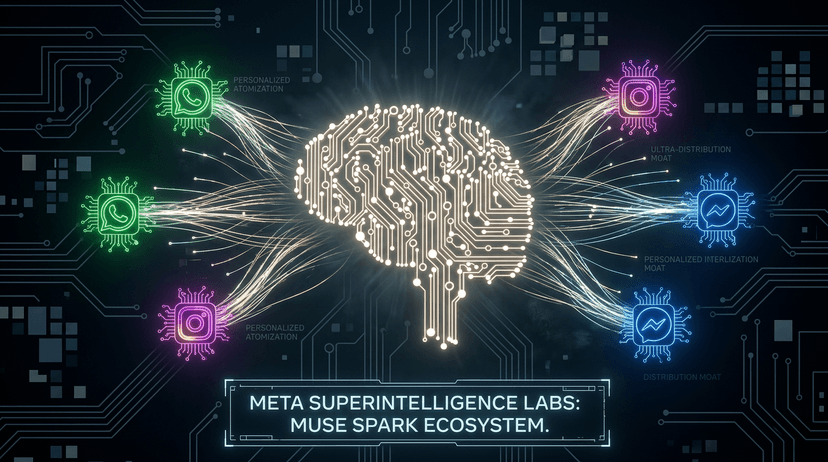
Meta Muse Spark Brings Personal AI Into WhatsApp, Instagram, and Messenger. Here's What That Changes
Meta just launched Muse Spark, its most powerful AI model yet, and its first built under the newly formed Meta Superintelligence Labs. The announcement is bigger than a benchmark release. It signals a fundamental shift in Meta's AI strategy, a new chapter in the frontier model race, and a direct challenge to how the rest of the industry thinks about personal AI. Here is what it means and why it matters to anyone building serious workflows with AI today.